
Rash: Minnesota has changed the national narrative on immigration

Polls show that here and across the country there’s disapproval of ICE tactics gone too far.

Columnist Icon
The Minnesota Star Tribune
February 17, 2026 at 11:00AM
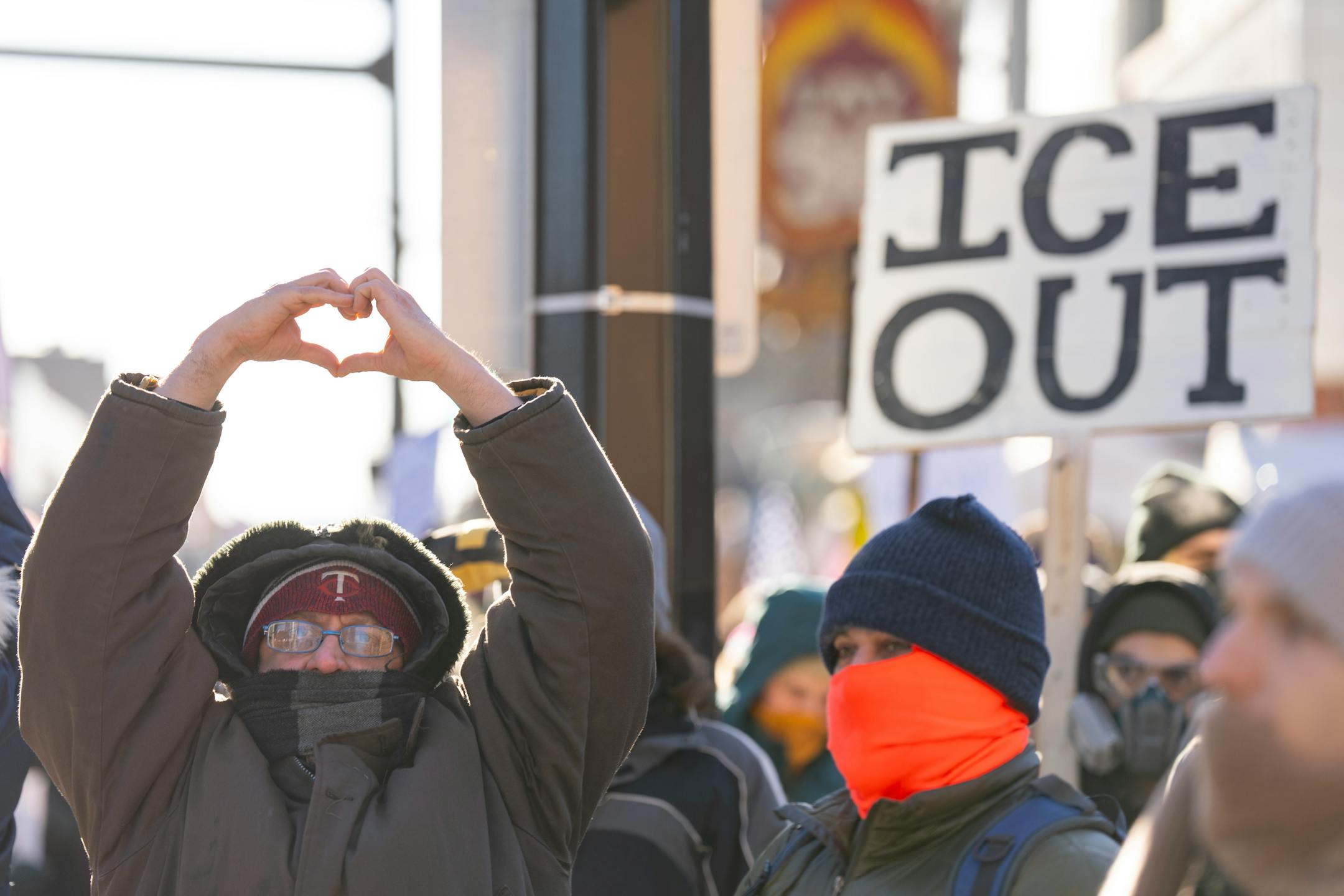
A protester holds up a heart with their hands as thousands march through the streets during an anti-ICE protest in downtown Minneapolis on Jan. 30. (Alex Kormann/The Minnesota Star Tribune)

Opinion editor’s note: Strib Voices publishes a mix of commentary online and in print each day. To contribute, click here.

•••

On Feb. 12, Tom Homan announced a drawdown of the 3,000 federal immigration agents deployed to Minnesota.

The Trump administration’s border czar didn’t indicate where they’d go next.

But wherever they’re sent, the dynamics will be different because of Minnesotans’ principled and closely watched resistance to Operation Metro Surge.

So too will national politics, as evidenced by several recently released polls reflecting the impact of the ICE crisis in Minnesota.

Here at home, an NBC News Decision Desk/KARE 11/Minnesota Star Tribune poll reports that 66% of Minnesota respondents believe “ICE tactics have gone too far,” that 59% of Minnesotans “disagreed when asked whether law-abiding citizens have nothing to fear from ICE,” and that 90% of Minnesotans “said federal agents should not be granted immunity from prosecution for unlawful acts.”

These opinions are consistent countrywide in recent polls: 67% told NBC News that ICE tactics have “gone too far,” near mirroring the 65% who said the same thing in an NPR/PBS News/Marist poll and the 62% who indicated as much in an AP-NORC poll.

President Donald Trump’s approval ratings have commensurately come down, with NBC reporting 61% disapprove of the president.

So as far as the issue of immigration enforcement is concerned, forget Maine. Now it can be said that as Minnesota goes, so goes the nation.

“Among the political class in Washington and New York, Minnesota is flyover country,” said Larry Jacobs, the director of the Center for the Study of Government and Politics at the University of Minnesota. True, there is occasional focus on tragedies, but for the most part, Jacobs said, Minnesota is “not really the center of national attention.”

Yet in recent weeks “we have seen the images and stories in Minnesota dominating the national news.” And that’s now showing up in polls. Across the country, continued Jacobs, “there is just a visceral backlash against the president and the conduct of ICE in other states that parallels what we’re seeing in Minnesota.”

And some of the polling is due to what we’re not seeing.

“Usually, when you see people in the streets, the agenda is set against them,” said Kathleen Hall Jamieson, the director of the University of Pennsylvania’s Annenberg Public Policy Center. “To the extent that Minnesotans have peacefully protested, the images are running counter to what is ordinarily expected to get into the news — ordinarily it takes violence and disruption.”

Jamieson, a Minnesota native who’s a nationally renowned expert on political communication, said that to the country the “impressive display of restraint” is “democracy in action” that makes it hard to marginalize by labeling it antifa or another group or movement. To those watching nationally, “the protesters don’t sound partisan” but “sound as if they are grieving.”

Mourning the deaths of Renee Nicole Good and Alex Pretti at the hands of federal agents, to be sure. But Jamieson said they also sound like they’re grieving “about a constitutional, democratic system faltering.”

The protesters’ presentation has cut through the cluttered news environment to such a degree that it’s changed the national narrative about the immigration issue to where it’s a polling liability, not a strength, for Trump.

“If you want to see a change in public opinion, you’ve got to break past partisan filters,” said Jamieson. “And the way to break past partisan filters is to have the people on one side see their leaders lying about what is known and what is seen and then have visual demonstration that it is false.”

Accordingly, the partisan filters usually sorting polls is different.

Referencing the statewide results, Jacobs said that “This is one of the most striking polls I’ve seen. The thing that really stands out is the intensity of the reaction; it’s not surprising that Democrats would have such a visceral reaction to the connection to the conduct of ICE and the president’s handling of immigration. But throughout this poll, you have seen the swing vote in the suburbs and among independents also have a very strong negative reaction.”

In fact, in percentages approximating the Twin Cities, where 82% of residents say ICE tactics have “gone too far,” the suburbs are close behind at 71%, a ratio relatively reflected in presidential approval: 71% of Minneapolis and St. Paul residents strongly or somewhat disapprove of how Trump “is handling his job as president” compared to 65% of suburban respondents.

In Minnesota, Jacobs stated, “you can’t win a statewide race if you’re not winning in the suburbs.” (And greater Minnesota may not look so good for Republicans if the impact of immigration enforcement forces farmers into crisis mode.)

Across America, what’s happening in Minnesota is impacting politics.

The Minneapolis images, said Jacobs, “have burned a deep scar into the country and ignited a deep concern toward Donald Trump and the Republican Party in the day and age when national politics, meaning the president and his approval and general economic sentiment, play a dominant role.” (Jacobs added that there were dangers for Democrats in poll results, too, because there is still strong national support for border control. If candidates overly play to their base, for instance, “they are going to have a problem with Republicans seizing on language about abolishing ICE and converting it into attacks on attacks on Democrats for favoring an open border and opposing enforcement of existing laws.”)

Alongside the searing images are soothing ones. “The other piece of the Minnesota narrative here is an ordinary person who is gathering up food in order to bring it to a person who is hiding and afraid to go to work, children afraid to go to school,” said Jamieson. “This isn’t simply peaceful protesting; this is also a model of community that in a polarized world, frankly, I thought we had lost.”

Polls reflect what people think about what happened here, but not yet what they think about Minnesota itself. Will it revert to flyover land? (A status many may miss after years of tumult.) When will “ICE out!” return to “ice out” and the countdown to the fishing opener?

These and other aspects in how the country considers Minnesota will be eventually evident in polls. But for now, consider this thought from a leading scholar on public opinion:

“I’m very proud of being a Minnesota native when I watch those people protest,” Jamieson said.

about the writer

about the writer

John Rash

Editorial Columnist

John Rash is a columnist.

See Moreicon

More from Columnists

See More
card image
Alex Kormann/The Minnesota Star Tribune

Polls show that here and across the country there’s disapproval of ICE tactics gone too far.

card image